July 07, 2026
, in technology
How popular is AI?
Public attitudes toward AI remain divided across geography and generations. Find out why with Eidosmedia.
Why People Are Skeptical About AI
KEY POINTS
- AI enthusiasm isn't universal. Public opinion remains deeply divided, with skepticism particularly high in the U.S. and among younger generations.
- There are multiple sources of alarm. Concerns over privacy, jobs, regulation, and data centers continue to shape attitudes toward AI.
- Governance will shape adoption. Transparent policies and human oversight are becoming essential to earning public trust.
If you believe the media hype, AI deployment is inevitable, but recent polls show deep division in attitudes toward AI applications. More tangibly, commencement speakers who dared laud AI were booed by graduates who are less than bullish on AI’s future. From age gaps to international divides, there is little consensus in public sentiment toward AI.
Gen Z and Americans seem to be the most skeptical about this technology boom, but it’s not all about the tech itself. Why are opinions still so varied, and what are the implications for AI development going forward? Join Eidosmedia as we explore the many factors weighing on consumer minds.
How people really feel about AI
In the United States and in Italy, half of people are more concerned than excited about AI, according to Pew Research. Australia, Brazil, Greece, and Canada are close behind with 45% or more of people sharing the same sentiments. South Korea, India and Israel are at the bottom of the 25-country list with concern outweighing excitement in just 16%, 19%, and 21% of respondents.
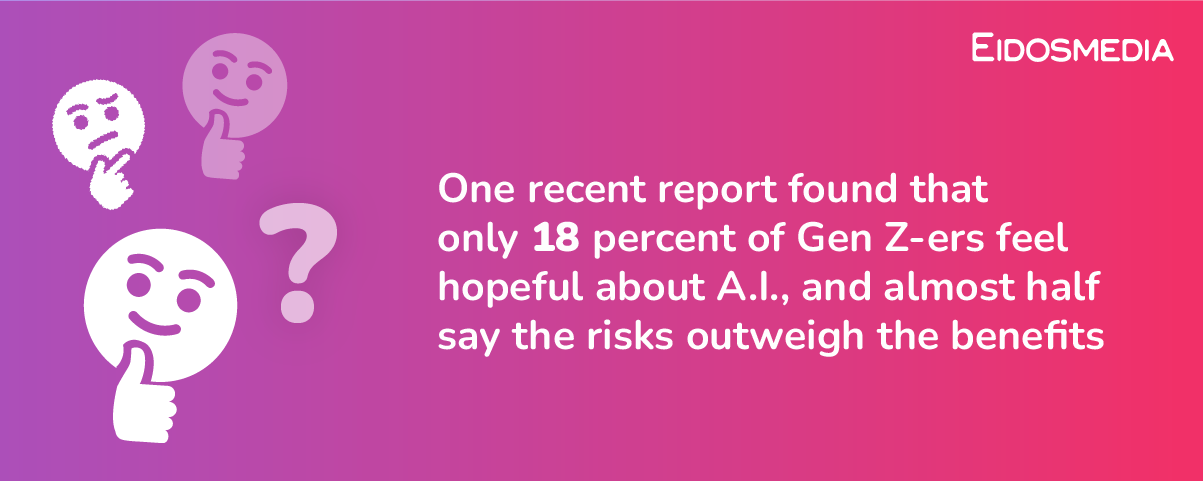
A Quinnipiac Poll confirmed that the distrust for AI runs deep in the U.S. After surveying 1,400 U.S. adults, Quinnipiac University found that 55% felt AI would do more harm than good, which was up 11% year-over-year. Additionally, 76% reported that they trust AI “hardly ever” or “only some of the time.” And a full 62% simply are not excited about the technology. Start parsing the data by age and not just geography, and you will find that skepticism grows. As The New York Times (NYT) reports, “One recent report found that only 18 percent of Gen Z-ers feel hopeful about A.I., and almost half say the risks outweigh the benefits.”
When Pew Research decided to dig deeper and look at more than just general attitudes toward AI, they found some nuance. Americans are worried about AI’s impact on creativity and even personal relationships, but they seem fine with using it for data analysis. From forecasting weather to developing new medicines, Pew’s respondents were willing to give AI a chance to prove its worth in important fields. Letting AI take the lead on predicting natural disasters or developing a lifesaving medicine makes sense when considering risk vs reward.
On the other hand, Pew found “only about a quarter said AI would have positive impacts on education (24%) and how people do their jobs (23%).” Considering “six-in-ten say students at their school use chatbots to cheat at least somewhat often,” the fears about AI’s impact on education seem more than reasonable. “Fewer say they use chatbots for more personal reasons, such as casual conversation (16%) or emotional support or advice (12%).” So, all hype aside, it’s safe to say that the people are not as pro-AI as companies and their PR staff would have us believe.
Why are so many pessimistic about AI?
From fears about job loss to privacy concerns, there are plenty of reasons people are skeptical about AI — but many people have structural concerns. At the NYT put it, “One reason Americans seem to despise A.I. more than people in other countries is that they know our government is too sclerotic to handle it.”
Other countries have taken a more active role in controlling how and when AI is deployed. As NYT noted, “Japan uses public funding and regulatory policy to encourage companies to use A.I. to complement work by humans rather than replace it.” Thousands of miles away, in Scandinavia, “workers often have a formal role in deciding how A.I. will be deployed and can use acceptance of it as a bargaining chip.”
Annenberg Public Policy Foundation found another key sticking point for people: “Nearly half of Americans (49%) oppose construction of new data centers in their area, while just 1 in 5 (21%) support it.” As energy costs soar and citizens who live next to data centers report impact on water supplies, animosity is growing. According to a Gallup poll, “Seven in 10 Americans oppose constructing data centers for artificial intelligence in their local area, including nearly half, 48%, who are strongly opposed. Barely a quarter favor these projects, with 7% strongly in favor.”
It seems that more and more, regular people simply do not think the costs of AI are worth the potential benefit, and much of that has to do with government’s lack of willingness to impose controls on the technology and its creators.
What’s next for AI governance?
It’s clear, people want AI governance. In countries where leadership is taking an active role in ensuring AI is used responsibly and with the best interests of people in mind, concerns are fewer. Companies should take note.
Explicitly stating AI policies — and how and when AI data will be used — can help assuage customer and employee fears. Some companies are already moving in this direction. EY’s “ As AI moves from advice to authority, who defines its limits? ” reports, “For example, Tokio Marine Holdings, an insurance multinational, adopted a public AI policy as part of using AI for claims processing, fraud detection and for other customer service activities, to earn trust in the highly regulated insurance industry. Released in 2025, the policy states that the company will not rely on AI data or techniques that could introduce biases against any group, and that AI-based functions and decisions will always keep people in the loop. It further states that the company will prevent AI use that violates human rights, distributes false or biased information, or leads to leaks, falsifications or unauthorized use of personal information.”
Four steps to building trust
The EY report takes things a step further and outlines next steps for leaders who want to implement AI solutions without compromising the trust of their employees and their consumers:
- Lead with experience, not promises: Build trust through use. Prioritize AI applications that deliver clear, everyday value and allow people to review, override or opt out as confidence grows.
- Segment by AI readiness, not demographics: People and markets are progressing at different speeds. Design experiences, messaging and controls that meet users where they are, rather than assuming a single path to adoption.
- Make trust visible: Providing clear disclosures, strong data protections, human‑in‑the‑loop options, and transparent accountability is no longer a differentiator. It is a prerequisite as autonomy increases.
- Design for emotional context: As AI takes on higher‑stakes tasks, design that takes into account empathy, simplicity and pacing is as important as performance. Design is not a finishing touch; it is a strategic catalyst for trust and adoption.
Understanding the very real concerns of the humans being impacted by AI, and the limitations of the technology itself, is integral to successfully using AI in day-to-day operations while maintaining trust. So is realizing not everyone wants to interact with AI, and that implementing the wrong tools — with no ability to opt out — may just cost businesses more in the long run.
FAQ: How Popular Is AI?
1. Is public opinion about AI mostly positive?
No. Attitudes are deeply divided worldwide, and in several countries — including the U.S. and Italy — concern about AI outweighs excitement for about half of people.
2. Who is most skeptical about AI?
Americans and Gen Z stand out as the most wary groups. Only about 18% of Gen Z-ers feel hopeful about AI, and nearly half say the risks outweigh the benefits.
3. How many Americans think AI will do more harm than good?
A Quinnipiac poll found 55% of U.S. adults believe AI will cause more harm than good, an 11-point jump from the previous year.
4. Which countries are least worried about AI?
South Korea, India, and Israel show the lowest levels of concern, with only 16–21% of respondents saying worry outweighs excitement.
5. Are people against all uses of AI?
No. Many are open to AI in fields like weather forecasting and medical research, where the potential benefits are seen as outweighing the risks.
6. Where are people most uneasy about AI?
Education and personal relationships. Only 24% expect AI to positively impact education and 23% expect it to help how people do their jobs.
7. Why are Americans particularly distrustful of AI?
Part of the concern is structural: many Americans feel their government isn't equipped to regulate AI effectively, unlike countries with more active oversight.
8. How do other countries approach AI differently?
Japan uses funding and policy to steer AI toward complementing human work, while in Scandinavia workers often help decide how AI is deployed in their workplace.
9. How do people feel about AI data centers?
Largely negative. Gallup found seven in ten Americans oppose new data centers in their area, citing concerns like energy use and water supply.
10. What steps does EY recommend for responsible AI adoption?
Lead with real-world value over promises, tailor rollout to readiness rather than demographics, make trust and safeguards visible, and design with emotional context in mind.
About Eidosmedia
Eidosmedia is a global supplier of advanced content-management and digital publishing systems.
Its products are used by large news-media groups for print and digital publishing and by financial service firms for the creation and dissemination of research and guidance.
Customers include business dailies The Financial Times and The Wall Street Journal , as well as generalist news publications like The Times of London, The Boston Globe and Le Figaro .