November 11, 2026
, in technology
To sue or to sign? The AI choice for news media
As landmark lawsuits against AI companies make their way through the courts, some publishers are choosing to sign deals while others continue to seek legal redress.

News Publishers vs. AI: Lawsuits, Licensing and Fair Use
KEY POINTS
- AI is reshaping news consumption. Declining referral traffic and growing chatbot use threaten publishers’ business models.
- Fair use is at the center of the debate. Courts must decide whether AI training on copyrighted news content is lawful.
- Publishers are split between lawsuits and licensing deals. Some are suing AI companies, while others are negotiating agreements.
Scraping and reshaping
The training of every Artificial Intelligence (AI) model involves the ingestion of copious amounts of human-generated data—and that often comes in the form of high-quality, expensive-to-produce news content.
Predictably, publishers have not been thrilled about tech companies scraping their content for free and repurposing it to answer users’ questions, at the same time as cannibalizing their reader traffic. So, nearly as soon as generative AI burst on the scene, the tension between content creators and the AI companies found its way to the court system.
Now, as the landmark case of the New York Times vs. OpenAI approaches judgement, we look at which news publishers have made their peace with the AI players and those who continue to fight the unpaid use of their content, and what it means for the future of news.
Signing instead of suing
The Times may have gone the lawsuit route, but other outlets have taken an entirely different path by signing agreements with specific AI engines—and some have decided to do both.
CNN sued Perplexity but inked a deal to let Meta use its content. NewsCorp did the same. U.S. News and World Report, Ziff Davis, and The Center for Investigative Reporting are among the long list of publishers taking on OpenAI and Microsoft.
Meanwhile, the Washington Post, Guardian, and Axios are all choosing to make a deal with OpenAI. Even The New York Times has made a deal with Amazon.
Mostly for the big boys
According to Press Gazette, “It was reported in 2024 that OpenAI was offering news organisations between $1m and $5m per year to license their copyrighted content to train its models – although News Corp’s deal was reportedly worth more than $250m over five years.”
Smaller publishers have been largely left out of these deals.
Even if licensing deals may soon be compulsory, questions remain. The Media Copilot raises valid concerns: “There is no settled model yet for who would collect payments, how rates would be set or how money would be distributed among large and small publishers.” Still, if the Times’ court case resolves in its favor, it could give more power to legislation already under consideration, providing protection for smaller publishers and more leverage for bigger players.
Does fair use apply to generative AI?
The question at the heart of the New York Times’ case is whether or not OpenAI’s use of its content to train its models—and respond to queries—is fair use. Stanford defines fair use as “any copying of copyrighted material done for a limited and ‘transformative’ purpose, such as to comment upon, criticize, or parody a copyrighted work. Such uses can be done without permission from the copyright owner.”
OpenAI claims its use of journalistic content is transformative, though it’s hard to see how it would qualify as commentary, criticism, or parody.
“The lawsuit, brought to light in Manhattan's federal court, claims these tech giants have violated copyright laws,” reports DevDiscourse. “Their defense hinges on the argument that the AI transforms original copyrighted material into new, non-competing content. However, journalists and publishers see it as a direct threat, potentially replacing traditional news gathering and reporting.”
After an interview with New York Times Assistant General Counsel Karen Chesley, INMA summarized The Times’ case into five key points:
New reporting suggests even OpenAI knows the impact it has on the journalism outlets it depends on to train its models. Reuters reported on unsealed court documents containing statements from OpenAI co-founder Greg Brockman, Microsoft CEO Satya Nadella, and head of ChatGPT Nick Turley, acknowledging AI products can act as a substitute for journalism.
"The evidence revealed here for the first time shows that OpenAI and Microsoft knew that what they were doing was wrong," commented Steven Lieberman, an attorney for the New York Daily News.
News-consumer and youth audiences are the hardest hit
Research from Reuters Institute shows there are plenty of reasons to worry about the impact of AI chatbots on journalism: “Uptake of AI chatbots, both in general and for news, continues to be driven by younger people, typically at the forefront of tech adoption, including AI.
The proportion of respondents in the youngest age group using chatbots for news (17%) is three times higher than that in the oldest age group (5%), although the most significant growth relative to 2025 was recorded among those 25–34 (up 4pp).”
Perhaps more concerning for publishers is that the uptake in chatbot use is among those already the most engaged with news. “Usage is considerably higher among news lovers (18% among these most intensive news consumers compared to 7% among those who get news just once a day) and is also higher among those with high interest in news (19% among those who are extremely interested relative to 7% among those not very interested).”
Reuters research across 45 markets showed that 42% of respondents ask chatbots while 35% use AI to get the latest news (35%). A similar proportion aim to simplify news consumption, “with 34% using chatbots for summarisation and 30% to make news easier to understand. At the same time, around a third (33%) report a more evaluative use, asking chatbots to assess the reliability of a news source.”
A crisis foretold
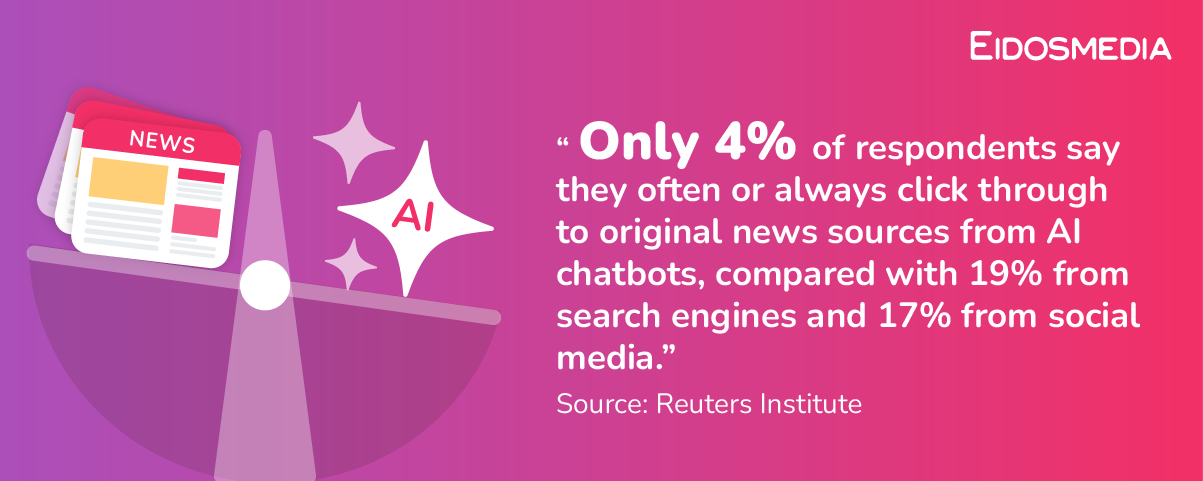
Concerns about AI search’s impact on traffic emerged nearly as soon as ChatGPT burst onto the scene. Gartner predicted traditional search engine volume would drop 25% by 2026 as users shift to AI chatbots and virtual agents for their answers. In fact, Reuters’ recent research showed that across 27 markets “just 4% of respondents overall say they always or often click through to underlying news sources from AI, compared with 19% from search, and 17% from social media.”
A pay-to-scrape licence?
The threat to publishers is real, and many may not want to wait for slow-moving court cases to decide their fate. While many publishers—especially those without the power to compel AI companies to make a deal—wait to see the result of the Times case, in Europe and Brazil government officials are contemplating moves to force AI companies to fairly compensate the news outlets they rely on to gather information. And, as The Media Copilot put it, “For publishers, the appeal is obvious. Licensing laws could offer a cleaner route to payment than years of copyright litigation, especially if courts keep moving slowly on training-data disputes.”
FAQ: To Sue or to Sign?
Why are news publishers in conflict with AI companies?
Publishers object to their content being scraped for free and reused to answer users’ questions, which also pulls readers away from their own sites.
What is the New York Times vs. OpenAI case about?
The Times argues that OpenAI used its content without permission to train its models and to answer user queries. The central question for the court is whether that use counts as “fair use” under copyright law.
What is fair use, and why does OpenAI say it applies?
Stanford defines fair use as copying copyrighted material for a limited, “transformative” purpose. OpenAI says its use is transformative because it turns original material into new, non-competing content.
Have all publishers chosen to sue?
No. Some have signed licensing deals instead, and some have done both. CNN sued Perplexity but signed a deal with Meta, while the Washington Post, the Guardian and Axios have made deals with OpenAI. Even the Times has a deal with Amazon.
How much are these licensing deals worth?
In 2024, OpenAI was reportedly offering news organizations $1m–$5m a year for their content. News Corp’s deal was reportedly worth more than $250m over five years. Smaller publishers have mostly been left out.
Which audiences are most likely to get news from AI chatbots?
Younger people: 17% of the youngest age group use chatbots for news, compared with 5% of the oldest. Use is also much higher among “news lovers” and people highly interested in news, who are the audiences publishers value most.
How is AI affecting traffic to news websites?
Only 4% of people say they always or often click through to news sources from AI answers. That compares with 19% from search and 17% from social media. Gartner predicted traditional search volume would drop 25% by 2026 as users move to chatbots.
Could new laws settle the dispute faster than the courts?
Possibly. Officials in Europe and Brazil are considering rules that would make AI companies pay the news outlets they rely on. But there is still no agreed model for collecting payments, setting rates, or sharing money fairly between large and small publishers.
About Eidosmedia
Eidosmedia is a global supplier of advanced content-management and digital publishing systems.
Its products are used by large news-media groups for print and digital publishing and by financial service firms for the creation and dissemination of research and guidance.
Customers include business dailies The Financial Times and The Wall Street Journal , as well as generalist news publications like The Times of London, The Boston Globe and Le Figaro .