October 05, 2026
, in technology
How to Build — and Lose — Audience Trust
Audience trust is increasingly key to publishers’ success. Eidosmedia looks at why it’s declining and how news organizations can rebuild it.

Audience Trust: How Publishers Can Build and Maintain It
KEY POINTS
- Trust is harder to earn. Misinformation, AI-generated content and social media are making audiences increasingly skeptical of news sources.
- Transparency makes a difference. Showing who creates the news, how stories are produced and what standards guide them can strengthen credibility.
- Strong brands build relationships. A clear identity, visible expertise and authentic connection can turn audience trust into long-term loyalty.
News media companies have long considered metrics like audience reach and engagement to be the best indicators of business success. However, recent studies have shown that audience trust is, in fact, a much better predictor of business sustainability. But given that trust is subjective, and far more difficult to secure than passive views or fleeting interactions, it can be a challenging thing to earn — especially in the age of misinformation.
In this article, we look at the nature of audience trust, how it’s been threatened, and how it can be regained.
Understanding audience trust
A paper written by academic Tali Aharoni defines trust in news media as “audiences’ willingness to be vulnerable to media objects spanning from individual news articles to the news media as an institution.” Being 'vulnerable' here means believing - and perhaps acting on - a news item without rigorously fact-checking the item or its source.
The Financial Times (FT) offers publishers a more practical definition in their recent report on the future of newsrooms: “We view audience trust as the relationship that is built when audiences are able to believe in the credible expertise of a news brand or journalist, feel affinity with the people behind the journalism and understand the intentions, perspectives and motivations behind the work.”
The most important thing to glean from these definitions is that audience trust no longer hinges on accuracy alone; modern audiences also want to understand how and why something is being reported, and feel a sense of “affinity” with those doing the reporting.
Disturbing statistics show how audience trust has changed
Given that misinformation has been a hallmark of the digital age — and has only been exacerbated by the recent influx of AI-generated content — it should come as no surprise that audiences have grown skeptical of once-trusted sources and credibility is at a premium.
In the U.S., where decrying “fake news” has become a mainstream political strategy, Gallup reports that “...confidence in the mass media has edged down to a new low, with just 28% expressing a ‘great deal’ or ‘fair amount’ of trust in newspapers, television and radio to report the news fully, accurately and fairly.” In 2020, trust was at 40%, showing just how quickly, and precipitously, trust in U.S. media companies has declined.
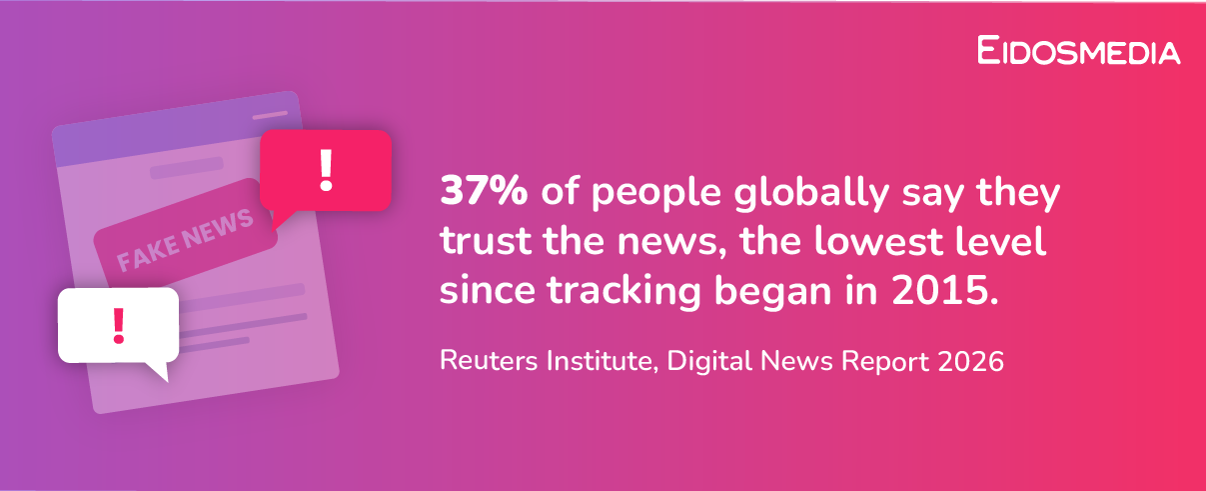
Unfortunately, this erosion of trust is not unique to the U.S. market. Reuters’ 2026 Digital News Report found that “Trust in news has fallen in 29 of our 48 markets this year, resulting in a drop overall to the lowest level we have recorded since we started to measure trust in 2015 (37%).” Reuters cites increasing distrust of “institutions and leaders,” fears of fake news up “62% on average,” and news consumption habits shifting more towards social media platforms — which “have long been trusted less than traditional news media” — as contributing factors to the overall decline in trust.
The role of social media
Social media, in particular, has proven to be a double-edged sword for news publications. On one hand, the desire for personalized content has driven more people to get their news from their social media feeds — and, in turn, given rise to news influencers. But on the other hand, trust in social media remains low; an Oxford study published in the Journal of Communication found “those who access news on social media have lower levels of trust in news.” The Oxford study identifies several reasons for the prevailing distrust of news on social media, including: the proliferation of “low-quality news and information,” the sheer abundance of sources begetting “confusion or uncertainty over what to believe,” “negative commentary” affecting “the perceived credibility of news stories,” and the rise of “content that is more attention-grabbing (such as clickbait) but less likely to engender trust.”
What can news organizations do to restore trust with their audiences?
Brand identity moves front and center
According to the CEO of the International News Media Association (INMA), Earl Wilkinson, earning trust requires a relationship with your audience, and a strong relationship depends on an indelible sense of brand. “‘To build a relationship, you have to be a brand that people remember,’” Punch quotes Wilkinson. “‘You must have consistency and an emotional connection. Do people trust you? You have to figure out who you are. The decade ahead belongs to those who are unmistakably themselves.’”
Jakub Górnicki, Co-Founder of Outriders Klub, echoes this sentiment in a recent piece for INMA: “‘Trust has become something journalism can no longer assume.’” Instead, Górnicki advises news brands to “‘...stop treating brand as the layer above journalism and instead make it the public interface of journalism.’”
FT’s report on the future of journalism agrees that building a strong audience relationship is the key to earning trust — and offers some practical advice. “Future-ready newsrooms are moving away from relying on institutional trust alone, toward a model that builds up greater relational trust. They do this by developing editorial capabilities that move audiences closer to the start of production; by making expertise more visible in their work; by focusing on producing formats that allow for authentic connection; and by being more transparent about how and why journalism is made.”
Trust through transparency
The effort to make the journalistic process more transparent has emerged as an especially popular tactic — and for good reason. Research conducted by Nieman “suggests that transparency is generally viewed positively by audiences and is often ranked highly when people are asked which trust-building strategies news organizations should prioritize.”
Reuters came to a similar conclusion when examining four techniques for building audience trust: editorial strategies that prioritize public interest, management that secures journalistic independence, engaging audiences in news production, and increased transparency. “Audiences rank transparency highly as a strategy for building trust, especially about ownership and funding but also editorial practices and ethical standards.”
Lifting the editorial veil
What does a more transparent approach look like in practice? In the U.S., where trust in the mainstream media companies is at an all-time low, publishers have started turning to individual journalists for help. Joe Kahn, executive editor of the New York Times, told Business Insider (BI) that, “...his outlet had moved to provide more information about reporters and their expertise and encouraged its journalists to address readers directly on platforms such as Instagram and TikTok.”
There has also been an insurgence of marketing campaigns designed to lift the editorial veil. “The BBC recently released a short film showing how it fights disinformation. Hearst Newspapers just announced a campaign, starting with the San Francisco Chronicle and Houston Chronicle, that promotes its local papers' role in keeping people informed.”
In a world where it’s become increasingly difficult to discern what is real from what is generated, it makes sense that audiences are eager for more insight into the editorial process, and the human beings who steward it.
FAQ: How to Build — and Lose — Audience Trust
1. What is audience trust, and why does it matter for publishers?
Audience trust is the audience's willingness to believe in a news brand without independently fact-checking it. Recent studies show it's now a stronger predictor of business sustainability than reach or engagement.
2. How is audience trust different from just being accurate?
Trust goes beyond factual accuracy. It also depends on audiences understanding a news brand's expertise, feeling a personal connection to the journalists, and grasping the motivations behind the reporting.
3. How much has trust in the media declined?
In the U.S., only 28% of people now express trust in mass media, down from 40% in 2020. Globally, trust has fallen in 29 of 48 markets tracked, hitting its lowest recorded level.
4. What's driving the decline in trust?
Key factors include the rise of AI-generated misinformation, political rhetoric around "fake news," and a broader distrust of institutions and leaders.
5. Does social media help or hurt news trust?
It's a mixed bag. Social platforms have made news more personalized and given rise to news influencers, but people who get news from social media consistently show lower trust levels.
6. Why do people trust news less on social media specifically?
Low-quality content, an overwhelming number of sources, negative commentary, and clickbait all erode credibility on these platforms.
7. How can a strong brand identity help rebuild trust?
Industry leaders argue that consistency and emotional connection are essential. Publishers that are "unmistakably themselves" are better positioned to build lasting audience relationships.
8. Why is transparency considered a top trust-building strategy?
Research shows audiences rank transparency highly, especially around ownership, funding, and editorial practices. It helps demystify how and why journalism gets made.
9. What are publishers doing to become more transparent?
Examples include highlighting individual journalists' expertise, encouraging reporters to engage directly on social platforms, and launching campaigns that show behind-the-scenes editorial work.
10. What's the biggest takeaway for news organizations?
Trust can no longer be assumed just because a brand is established. It must be actively earned through relationship-building, transparency, and visible human expertise.
About Eidosmedia
Eidosmedia is a global supplier of advanced content-management and digital publishing systems.
Its products are used by large news-media groups for print and digital publishing and by financial service firms for the creation and dissemination of research and guidance.
Customers include business dailies The Financial Times and The Wall Street Journal , as well as generalist news publications like The Times of London, The Boston Globe and Le Figaro .