June 10, 2026
, in technology
Will AI Coding Kill Paid Software?
Markets have been roiled by fears that AI coding assistants could create cheap alternatives to established software products. How justified is the alarm and what kind of software is at risk?
How AI Coding Tools Are Threatening the SaaS Business Model
KEY POINTS
- AI is making software easier to build. AI is making software easier to build.
- Workflow tools are most at risk. AI agents can increasingly replace task and process management software.
- Data and specialization are the new moat. Companies with proprietary data, compliance expertise, or niche solutions have the best chance of success.
Last year we asked “How good is A-generated code?” and got the answer “Not very – use with care”. A year later, AI coding has improved to such an extent that it’s caused what Business Insider describes as a “meltdown” for shareholders of software-as-a-service (SaaS) stocks.
Does AI finally pose a legitimate threat to established SaaS companies, or are market concerns overblown? Let’s take a look.
Understanding AI’s threat to the software business landscape
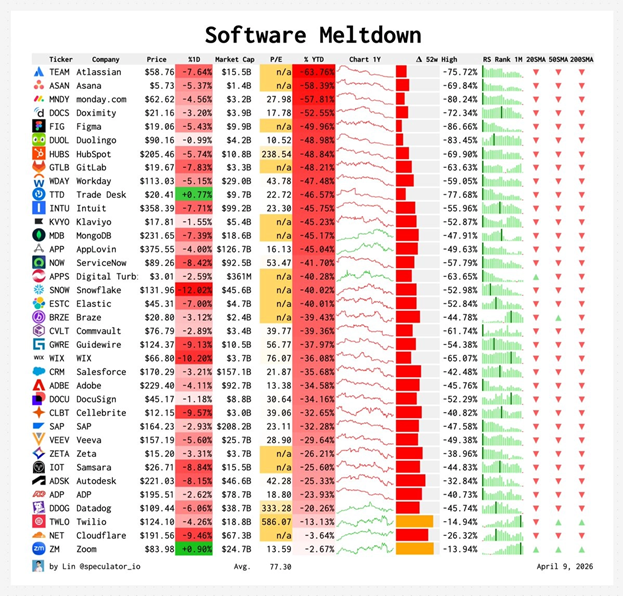
The SaaS market shakeup began in February when Anthropic, the company behind AI chatbot Claude, announced they were adding new tools to Cowork — the agentic AI arm of Claude — that could execute legal tasks like compliance tracking and document review. The following day, the prices of legal software stocks plummeted, and, as Business Insider put it, the “Contagion spread across the software sector like wildfire before spilling into broader tech.”
A week after Anthropic’s announcement, Bain and Company reported, “Broad software indices are now down by about 15% over the past few weeks and by about 25% from 12-month highs.”
Unfortunately for SaaS companies — and shareholders — things have not improved over the past couple of months, as AI-powered software tools continue to accelerate. In April, Claude announced Claude Code Security, which promptly triggered another drop in the share prices of SaaS companies, sparking fears of a “‘SaaS-pocalypse,’” according to 247 Wall St.
Canadian tech entrepreneur, Dan Martell, chalks the market’s reaction up to a simple matter of scarcity. “For 20 years, software was the scarce resource. You needed engineers to build it, maintain it, and scale it.” But now that AI tools like Claude “can spin up a functional product in a weekend,” software creators are no longer rare, and their products are no longer sacred.
“The SaaS model was always a bet that software would stay hard to build,” Martell concludes. “That bet is now underwater.”
Which software companies are being hit hardest by AI?
Not all software companies are created equal, and not all SaaS companies are being equally affected by the rise of AI coding tools.
SalesTable co-founder Suresh Madhuvarsu conducted a SaaS autopsy on LinkedIn, starting with a breakdown of the companies most vulnerable to AI disruption. “Atlassian down 63%, Asana down 58%, monday.com down 58%. Notice what these three have in common: their entire product surface area is workflow coordination between humans. Tickets, tasks, boards, assignments. That is precisely what AI agents do natively, for free, without a $15/seat/month license.”
On the flip side, the “relative outperformers” are companies like Zoom, Cloudflare, ADP, and Twilio. “That's not random,” says Madhuvarsu. “Cloudflare owns the network layer. ADP owns payroll and compliance, try automating around SOC 2, ERISA, and state tax law. Twilio is the messaging infrastructure layer. Zoom, despite everything, still owns the synchronous human communication primitive.”
The survivors aren’t “‘doing workflows’, they're the substrate workflows run on, or they're legally required. That's the moat in an agentic world.”
This assessment aligns with what we’ve seen play out across industries; AI is not yet capable of navigating human complexities like tax laws, but it’s more than equipped to handle the coordination of human workflows.
How software companies can adapt to the changing landscape
So where do software companies go from here? Suresh Madhuvarsu believes SaaS survivors will undergo three specific shifts:
- Prioritize customer data: Instead of focusing on rolling out new product features — all of which can be replicated by AI code — Madhuvarsu advises software companies focus on “customers' proprietary data.” “If your product isn't building a data asset that gets more valuable with each customer interaction (audit trails, institutional memory, domain-specific training signal),” Madhuvarsu warns, “you're building on sand.”
- Build trust instead of automation: If the current state of the SaaS market is the north star, “automating workflows isn't defensible anymore.” However, “What's defensible is being the system of record for who approved what, why, and with what constraints. Compliance surfaces, audit layers, and explainable decision trails are now product features, not IT afterthoughts.”
- Vertical specificity over horizontal scale: “Generic CRM for everyone is a hard sell when an AI agent can instrument the same workflows without the license,” says Madhuvarsu. “But a CRM purpose-built for CDFIs with embedded lending compliance logic, or one built for regulated financial institutions where the workflow is the compliance artifact, that's a different product in a different market. Vertical specificity is now a survival strategy, not a go-to-market tactic.”
Madhuvarsu’s takeaways are actionable and specific, but if they are not precisely relevant to a niche SaaS offering, Dan Martell offers broader advice. “We’re not in a software correction. We’re in a software replacement. The companies that survive this aren’t the ones with the best code. They’re the ones that figured out what their business actually is – underneath the software layer that used to protect them.”
Bain and Company echo this assessment. “Software CEOs and boards need to be clear-eyed about where they sit, what bets they are making, and how fast they are moving.
“That starts with staying close to customers and understanding what problems they are desperate to solve, what parts of their labor stack they need to make more efficient, and where agents can truly deliver value.”
For those SaaS companies unwilling to take the threat of a SaaS-pocalypse lying down, a strategic assessment of offerings, structure, and the needs of their customers is imperative. AI is here to stay, so the real SaaS winners will be those who are willing to take a hard look under the hood and identify where AI can help, and, more importantly, where it cannot — that’s where the opportunity for ingenuity, and a sustainable business model, will be.
FAQ: Will AI Coding Kill Paid Software?
1. What triggered the recent 'meltdown' in SaaS stock prices?
The meltdown began in February 2026 when Anthropic announced agentic AI tools capable of executing legal tasks like compliance tracking. Legal software stocks plummeted immediately, and contagion spread across the sector — broad software indices fell roughly 15% in weeks and 25% from their 12-month highs.
2. How much has AI coding improved in recent years?
Dramatically. Just a year ago, AI-generated code was 'not very good — use with care.' Today, AI coding tools can spin up functional software products in a weekend, a task that previously required significant engineering resources.
3. What is the core reason AI poses a threat to the SaaS business model?
The SaaS model was built on the premise that software would remain hard and expensive to build. AI coding tools have shattered that premise, removing the competitive moat that SaaS companies relied on for two decades.
4. Which types of SaaS companies are most vulnerable to AI disruption?
Companies whose core product is workflow coordination — Atlassian, Asana, monday.com — are most at risk. Their platforms handle tickets, tasks, and assignments, which AI agents can perform natively without a per-seat licence fee.
5. Which SaaS companies are holding up best, and why?
Cloudflare, ADP, Twilio, and Zoom are relative outperformers. They own critical infrastructure layers, are legally mandated, or provide irreplaceable communication tools — they are the substrate workflows run on, not the workflows themselves.
6. How should SaaS companies think about customer data going forward?
Rather than competing on features — which AI can replicate — companies should build proprietary data assets that grow more valuable over time: audit trails, institutional memory, and domain-specific training signals that AI alone cannot easily reproduce.
7. Is automating workflows still a defensible business strategy?
Not on its own. What remains defensible is serving as the system of record for decisions — tracking who approved what, why, and under what constraints. Compliance surfaces and explainable decision trails are now competitive product features.
8. What is 'vertical specificity' and why does it matter now?
Building software tailored to a narrow, regulated industry rather than offering generic horizontal tools. A CRM purpose-built for regulated financial institutions with embedded compliance logic is far harder for AI to replace than a generic alternative — making vertical focus a survival strategy.
9. Is this just a market correction, or something more fundamental?
Something far more fundamental. Analysts and entrepreneurs cited in the article call it a structural software replacement, not a temporary correction. Survivors are those who can identify what their business is underneath the software layer — and adapt.
10. What is the key takeaway for SaaS companies that want to survive?
Conduct an honest strategic assessment of offerings and customer needs. Identify where AI can help and, more importantly, where it cannot — because that gap is where genuine ingenuity and a sustainable business model can still be built.
About Eidosmedia
Eidosmedia is a global supplier of advanced content-management and digital publishing systems.
Its products are used by large news-media groups for print and digital publishing and by financial service firms for the creation and dissemination of research and guidance.
Customers include business dailies The Financial Times and The Wall Street Journal , as well as generalist news publications like The Times of London, The Boston Globe and Le Figaro .